Vacation Rentals
airbnb arrival guide template
airbnb arrival guide template
A well-prepared Airbnb arrival guide can make or break your guest's first impression. It simplifies the check-in process, reduces guest confusion, and saves you from answering repetitive questions. Here's what you need to know:
- What it is: A short guide sent 24–48 hours before check-in with key info like address, parking, entry codes, and Wi-Fi details.
- Why it matters: Hosts using detailed guides report up to 72% fewer guest questions and a +0.4-star rating boost on average.
- How to create one: Include clear steps for arrival, entry, and settling in. Use digital tools like Howard to keep it current and easy to update.
- Key tip: Place Wi-Fi info and entry codes at the top for quick access.
An arrival guide ensures a smooth start for guests and less stress for you as a host. Keep it clear, concise, and easy to access.
How to Create an Airbnb Welcome Book with Canva: Easy Step-by-Step Tutorial for Hosts, with Template
sbb-itb-ec91689
Core Components of an Effective Airbnb Arrival Guide
A well-crafted arrival guide is like a roadmap for your guests, addressing their needs at three critical stages: before arrival, getting inside, and settling in. It's all about providing clear, timely answers to eliminate confusion.
Guest Arrival Logistics
Start with the fundamentals. Share the full property address, including any specific details like "Unit 3B" or "Back house, second gate on the left." Pair this with easy-to-follow written directions for the final approach. Adding a photo of the building's exterior or a nearby landmark - like a red mailbox or a blue planter - can help guests confirm they're in the right spot.
Clearly state your check-in and checkout times (e.g., "Check-in starts at 4:00 PM; checkout is by 11:00 AM") and provide detailed parking instructions. For example, "Park in Spot #12, marked with a yellow stripe", is far more helpful than a vague "parking available on-site." If your guests are arriving without a car, include the nearest public transit stop, a local taxi service number, or a rideshare drop-off location.
Once you've covered these basics, the next step is to make the entry process seamless.
Access and Entry Instructions
Check-in is often the most nerve-wracking moment for guests, so this section needs to be crystal clear.
"Check‑in is the moment guests are most anxious. Your job is to reduce uncertainty." - BeMyGuest
Lay out the entry steps in a simple, step-by-step format. For instance:
- Locate the left-side lockbox.
- Enter code 4829.
- Ensure the door auto-locks.
If you use a smart lock, mention whether it locks automatically to avoid any security mishaps. Always include a backup plan, like a secondary lockbox code or a way to contact you in case of issues.
Once guests are inside, shift focus to helping them feel at home.
In-Stay Essentials
After tackling arrival and entry, your guide should ensure guests have everything they need to enjoy their stay. Start with the basics: display the Wi-Fi name and password prominently near the entry. Then, address common questions about appliances and systems. For example, explain how to adjust the thermostat (and mention any temperature limits), operate the coffee maker, or switch TV inputs.
Don't forget safety details. Highlight where to find the fire extinguisher, first aid kit, and circuit breaker. Provide local emergency contact information and the closest urgent care clinic. The table below outlines key reminders for each category:
| Category | Key Reminders |
|---|---|
| Connectivity | Wi-Fi name/password, streaming service access |
| Climate | Thermostat limits, HVAC instructions |
| Kitchen | Appliance tips, grill usage |
| Safety | Fire extinguisher location, emergency contacts |
| House Rules | Quiet hours, trash/recycling, smoking policies |
Airbnb Arrival Guide Template
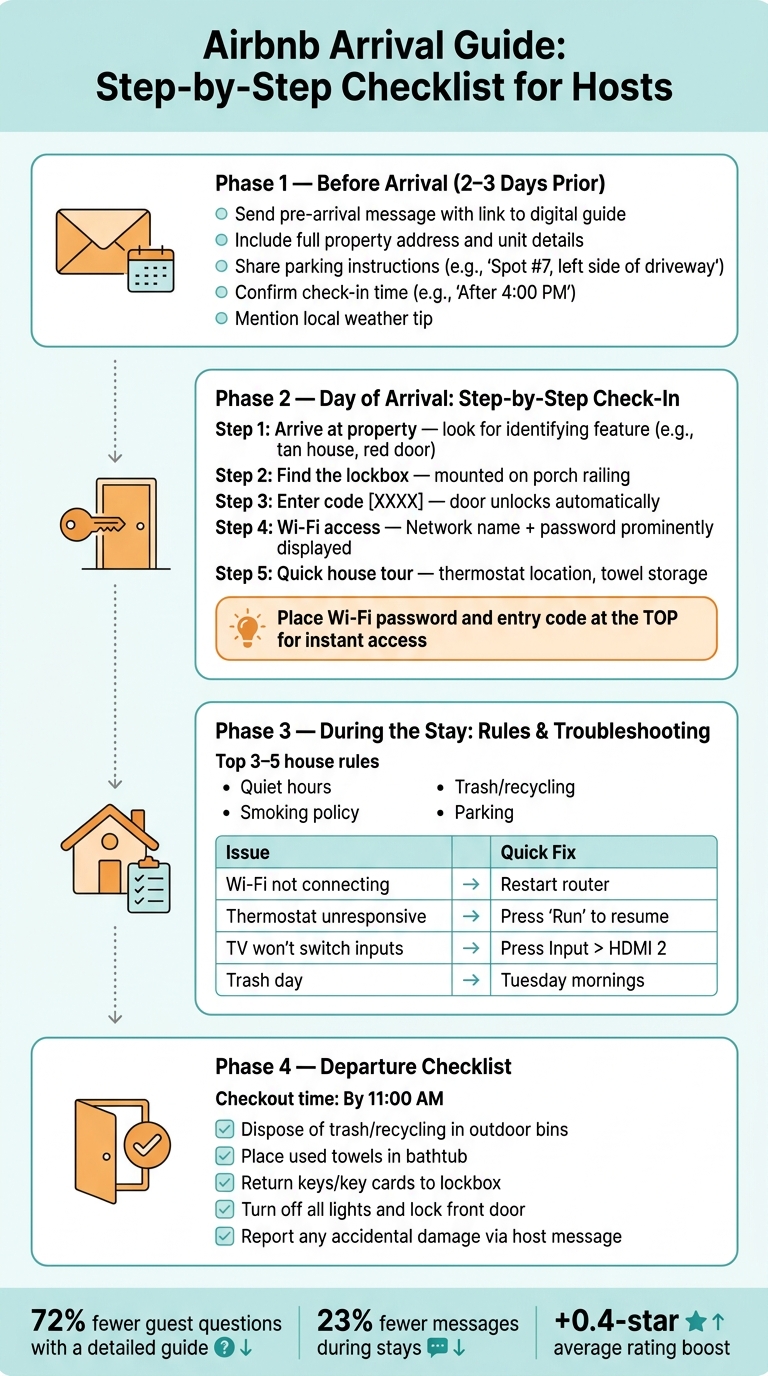
Airbnb Arrival Guide: Step-by-Step Checklist for Hosts
Here’s a handy template to help you craft your own arrival guide, building on the essential components outlined earlier.
Before Arrival: Preparing Your Guests
Send a pre-arrival message 2–3 days before check-in, including a link to your digital guide. This gives guests enough time to review everything without feeling rushed. Don’t forget to mention the local weather to help them pack appropriately - something like, "Evenings in late October can drop to the low 50s°F, so bring a light jacket."
Make sure to personalize this section with your property’s details. Include:
- Your full property address and any specific unit details (e.g., "Unit 4A, enter through the side gate.")
- Parking instructions (e.g., "Park in Spot #7 on the left side of the driveway.")
- Check-in time (e.g., "Check-in is available anytime after 4:00 PM.")
- A link or QR code to your complete digital guide.
Day of Arrival: Step-by-Step Instructions
Provide clear, numbered steps to guide guests through the check-in process. Here’s an example format you can adapt:
- Arrive at the property - Look for the tan house with the red front door at [your address].
- Find the lockbox - It’s mounted on the left side of the porch railing.
- Enter code [XXXX] - The door will unlock automatically.
- Wi-Fi access - Network: HomeBase_5G | Password: sunshine2024
- Quick house tour - The thermostat is in the hallway, and extra towels are stored in the hall closet.
Place the Wi-Fi password and entry code at the very top of this section for easy access. As Airbnb host Marit Anne puts it: "They all want the wifi code, so that is my trick for having them open the house manual and hopefully read it."
Once your guests are settled in, shift the focus to guidelines that enhance their stay.
During the Stay: House Rules and Problem Solving
Address the top 3–5 rules that could cause misunderstandings - common examples include quiet hours, smoking policies, trash and recycling procedures, and parking. If a rule has been a recurring issue in the past, it definitely belongs in the guide.
For appliances or systems with tricky instructions, keep it simple. Use clear language and include photos when possible. For instance, a labeled photo showing how to start your induction stovetop can save guests (and you) a lot of time compared to a long explanation.
Create a troubleshooting section for common issues:
| Issue | Quick Fix |
|---|---|
| Wi‑Fi not connecting | Restart the router (white box in the living room). |
| Thermostat unresponsive | Check if it’s in "hold" mode; press "Run" to resume. |
| TV won’t switch inputs | Press "Input" on the remote, then select HDMI 2. |
| Trash day | Tuesday mornings; bins go to the end of the driveway. |
"You don’t want guests to feel like they have to walk across a minefield to keep the host happy. Find the right balance between your needs and making your guests feel welcome." - Tina, Airbnb Host
Departure Checklist for Guests
Make checkout as smooth as possible by giving guests a short, clear departure checklist. Stick to five steps or fewer to keep things simple:
- [ ] Dispose of trash and recycling in the outdoor bins.
- [ ] Place used towels in the bathtub.
- [ ] Return all keys or key cards to the lockbox.
- [ ] Turn off all lights and lock the front door.
- [ ] Report any accidental damage by messaging the host directly.
Be sure to clearly state the checkout time, such as "Checkout is by 11:00 AM," and remind guests where to leave the keys. This avoids last-minute confusion and ensures a smooth turnover for your cleaning team.
Delivering and Maintaining Your Arrival Guide
Choosing the Right Format
How you present your guide can be just as important as its content. The best strategy? Offer both a digital version and a physical backup. Digital guides cater to guests who plan ahead, while a printed QR code card left in a visible spot - like the kitchen counter - ensures accessibility for those whose phones are dead or who prefer something they can hold.
| Format | Best For | Note |
|---|---|---|
| PDF / Google Doc | Easy sharing via link; no extra cost | Can be hard to read on mobile; formatting issues may arise |
| Printed Binder | Guests without reliable phone access | Prone to wear and tear; quickly becomes outdated |
| Digital Guidebook Platform | Mobile-friendly, easy to update, polished design | Often requires a monthly fee |
Timing is everything. Airbnb automatically shares arrival guides with confirmed guests 48 hours before check-in. To streamline this process, consider using a centralized digital solution.
Using Howard to Centralize Your Guide
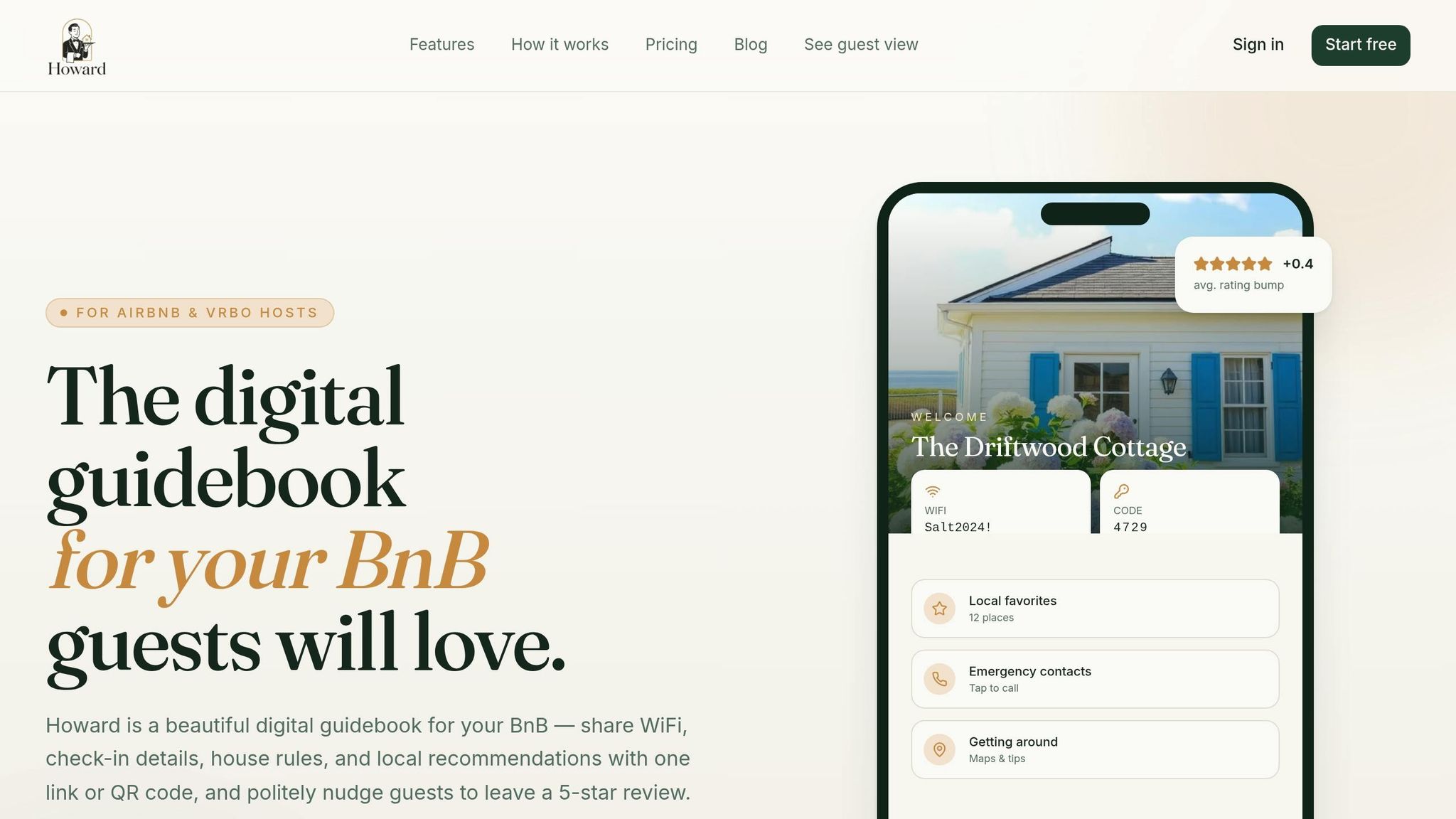
Managing multiple guide formats can work for a single property, but it becomes a logistical headache with multiple listings. A tool like Howard simplifies this by consolidating everything into a single link or QR code. It includes all the essentials: Wi-Fi details, lockbox codes, house rules, appliance instructions, local tips, and emergency contacts.
Setting up Howard is quick and straightforward. Hosts can import property details directly from their Airbnb listing in about 4 minutes, and the free Solo Host plan supports one property with no credit card required. For hosts with several listings, Howard’s dashboard allows you to duplicate and customize guidebooks in seconds. Plus, its AI-powered FAQ feature answers repetitive guest questions automatically, forwarding more complex queries to you via Slack or email. This approach has cut down guest inquiries by 72%.
"My superhost rating finally stopped slipping. Guests stop messaging me at midnight asking about the WiFi." - Margaret L., Host of 3 properties
Centralizing your guide also makes it easier to keep things updated, ensuring guests always have accurate information.
Keeping Your Guide Up-to-Date
An outdated guide can frustrate guests and lead to negative experiences.
"A house manual with a wrong WiFi password is worse than no manual at all." - Bart, GuestIntro Team
Make updates right after guest inquiries to address any gaps. Additionally, review your guide thoroughly twice a year to account for seasonal changes or updates to your property. A quarterly check on local recommendations ensures your suggestions for restaurants and activities stay accurate, especially since hours and availability often change.
"Update your welcome book at least twice per year, seasonal changes (pool rules, heating instructions, local restaurant closures) make outdated information a source of guest complaints." - GleamSync
Digital platforms like Howard make these updates seamless - any changes you make are instantly reflected across all guest-accessible versions. This keeps your guide current, your guests happy, and your hosting experience smoother.
Conclusion: Building a Better Guest Experience
An arrival guide does more than just answer questions - it creates a sense of welcome while saving you from repetitive inquiries. In fact, a 2025 host survey found that hosts who provide detailed digital guidebooks receive 23% fewer messages during stays and earn higher ratings in the "communication" category on reviews. That’s a win-win.
Beyond the practical advantages, how you present the guide plays a big role in shaping the guest experience. The key is simplicity and accessibility. Whether it’s digital, printed, or both, the guide should allow guests to find what they need in under 30 seconds, especially during the often hectic arrival process. As Be My Guest wisely notes:
"A 'perfect' welcome guide isn't the longest one. It's the one guests can actually use in the moment: on a phone, under time pressure, with limited attention."
For hosts managing multiple properties, centralized tools like Howard make the process seamless. With Howard, you can create a complete digital guidebook in about 4 minutes, manage multiple properties from one dashboard, and send instant updates. The free Solo Host plan supports one property with no credit card required, making it an easy and risk-free way to get started.
"Guests genuinely tell me how nice the guidebook is. It's the small touch that makes the whole stay feel premium." - Sofia R., Host of 8 listings
The takeaway? Great arrival guides don’t need to be complicated. They just need to be clear, complete, and current. Start with the basics, use straightforward language, and refine the guide based on guest feedback. Over time, it will become one of your most reliable tools as a host.
FAQs
How long should an arrival guide be?
An Airbnb arrival guide should strike the perfect balance between being thorough and easy to digest. Guests often need quick access to essential details, so aim for a document that's 1-3 pages or a short, mobile-friendly digital format.
Here’s what to include:
- Property Access: Provide clear instructions for getting into the property, such as key codes, lockbox locations, or smart lock details. Include any specific steps or troubleshooting tips to avoid confusion.
- Wi-Fi Details: Share the network name and password prominently. Consider placing this information both in the guide and somewhere visible on the property.
- House Rules: Outline the most important rules, like noise restrictions, parking policies, and pet guidelines. Keep this section concise but clear.
- Checkout Instructions: Offer a simple checklist for departure, such as where to leave keys, trash disposal, and any cleaning expectations.
- Emergency Contacts: Include your phone number, a backup contact, and local emergency numbers for added peace of mind.
Avoid overloading the guide with unnecessary details. The goal is to make your guests' arrival and stay as smooth as possible while keeping the information easy to scan, especially on a mobile device.
What should I do if a guest can’t get in?
First, make sure your guest has all the necessary access instructions. This includes clear details about how to use your entry method, whether it’s a smart lock, keypad, or lockbox. Send these instructions 24–48 hours before their check-in to avoid last-minute confusion.
If your guest still has trouble getting in, reach out through Airbnb messaging or give them a call to help troubleshoot the issue. To make things easier, include emergency contacts and step-by-step directions in your welcome guide. This can save time and help resolve access problems quickly.
How often should I update my arrival guide?
Regularly updating your arrival guide is key to providing a seamless experience for your guests. Make sure all details are accurate, especially information about the property, available amenities, and local tips. If anything changes - like new house rules, updated check-in instructions, or fresh restaurant recommendations - reflect those updates right away. Staying current not only makes your guide more useful but also helps guests feel welcome and well-prepared for their stay.