Vacation Rentals
Managing Multiple Airbnb Properties: The Complete Guide
Managing Multiple Airbnb Properties: The Complete Guide
Managing multiple Airbnb properties can feel overwhelming. But with the right systems, tools, and processes, you can save time, reduce errors, and grow your portfolio without sacrificing quality. Here's a quick breakdown of key strategies covered in this guide:
- Use a Property Management System (PMS): Centralize operations like calendar syncing, guest messaging, and task automation to save hours of work weekly.
- Automate Tasks: Schedule guest communications, cleaning, and pricing adjustments to streamline operations.
- Standardize Processes: Create templates for guest messaging, cleaning, and maintenance to ensure consistent service across properties.
- Build a Reliable Team: Hire dependable cleaners, maintenance staff, and co-hosts to handle the workload as your portfolio grows.
- Enhance Guest Experience: Use digital guidebooks to answer common questions and provide local recommendations, improving ratings and reducing inquiries.
- Optimize Maintenance and Pricing: Preventive maintenance reduces costs, while dynamic pricing increases revenue and occupancy.
These steps not only simplify day-to-day management but also help you scale efficiently while maintaining high standards.
How I Manage 20 Airbnbs Remotely (Full System Breakdown)
sbb-itb-ec91689
Using Property Management Systems to Simplify Operations
Key Benefits of Property Management Systems for Multi-Property Airbnb Hosts
Why a Centralized System Matters
Managing multiple Airbnb listings can feel like a juggling act. If your properties are also listed on platforms like Vrbo and Booking.com, you're likely spending hours switching between sites to check bookings, respond to messages, and update calendars. A property management system (PMS) simplifies this chaos by bringing everything together into one dashboard.
One of the biggest advantages of a PMS is real-time calendar synchronization. This means your availability updates instantly across all platforms, reducing the risk of double bookings. Another time-saver is a unified inbox, which gathers guest messages from all platforms in one place. No more logging in and out of different accounts.
"Without a PMS, managing five Airbnb listings is like running five separate small businesses. With a PMS, those five listings become one streamlined operation." – Hannah Gong, Smart Order
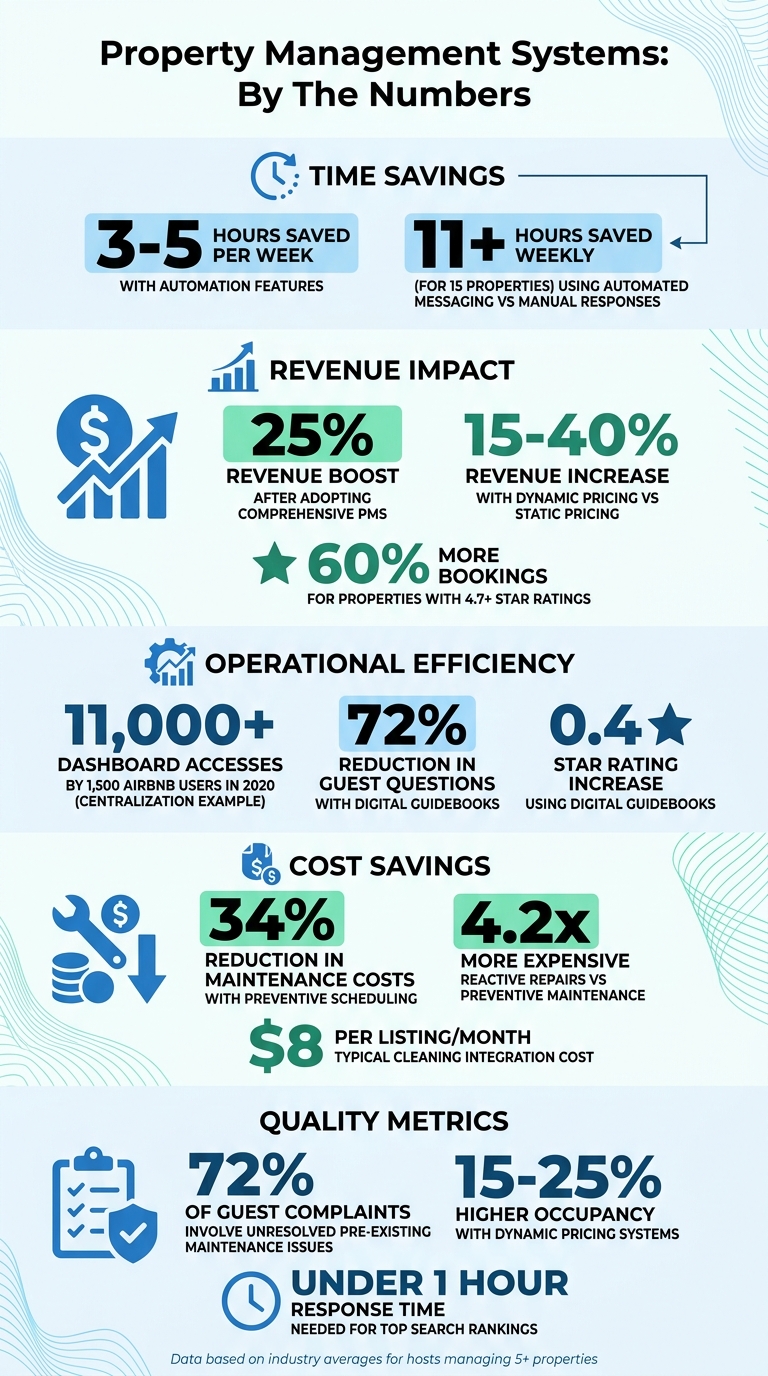
Airbnb highlighted the power of centralization during the pandemic. In March 2020, their analytics team created a dashboard using the Minerva platform. This tool became the go-to resource for tracking global bookings and cancellations, helping leadership adapt quickly to shifting trends. The dashboard was accessed over 11,000 times by 1,500 users in 2020, enabling a strategic pivot toward local travel.
Automation Features That Save Time
Centralization is just the beginning - automation takes efficiency to the next level. Modern property management systems handle repetitive tasks so you can focus on growing your business. For example, automated guest messaging can send booking confirmations, check-in details, mid-stay updates, and checkout reminders. Once you set up these triggers, the system takes care of the rest.
Smart locks are another major time-saver. A PMS can generate unique, time-sensitive entry codes for each guest and send them automatically, cutting out the need for physical key exchanges. Cleaning and maintenance tasks can also be scheduled automatically when guests check out. Many PMS tools integrate with platforms like Turno, which costs about $8 per listing per month, to streamline these processes. Additionally, dynamic pricing tools adjust rates based on demand, seasonality, and local events, helping hosts increase revenue by 15% to 40% compared to static pricing.
The impact is clear: property managers save an average of 3 to 5 hours per week with automation, and hosts often see a 25% boost in revenue after adopting a comprehensive system.
"I cannot describe the burden it relieved us of. Overnight, guest inquiries were being answered, allowing us to focus on other aspects of our business." – Charlie London, Co-founder, Seven Living
Creating Consistent Processes Across All Properties
Managing multiple Airbnb properties comes with its own set of challenges, and one of the biggest is maintaining consistency. Guests expect the same level of service across all your listings. If one property offers a smooth check-in process, guests will naturally assume the same seamless experience at your other locations.
"In hospitality, consistency in touchpoints like communication, check-in, and house rules helps reduce gaps between what guests expect and what they experience." – Hostify
Having standardized systems in place can also help you avoid costly mistakes. For instance, without clear processes, you might accidentally send a guest the wrong entry code or provide incorrect parking details.
Setting Up Guest Messaging Templates
Most guest inquiries revolve around common topics like check-in details, WiFi access, appliance use, or early check-in requests. Since these questions are so predictable, it makes sense to streamline your communication. Instead of typing out the same responses repeatedly, you can create message templates that automatically personalize details for each reservation.
Dynamic placeholders like {guest_name}, {check_in_date}, and {address} allow you to customize messages while still automating the process. You can schedule these messages to go out at key moments - such as when a booking is confirmed, before check-in, during the stay, and at checkout.
However, relying on generic templates can backfire if they don't include property-specific details. For example, a single property may have 40 to 80 unique questions, covering everything from appliance quirks to HOA rules and trash schedules. Building a knowledge base for each property might take 45 to 60 minutes, but this upfront work pays off in the long run.
"The tipping point for most property managers is somewhere between 8 and 12 properties. Below that, manual messaging is annoying but survivable. Above it, the inbox becomes a second job." – Hostrexa Team
To save even more time, use a draft mode that lets you review and tweak auto-generated messages before they’re sent. For a portfolio of 15 properties, this approach can save over 11 hours per week compared to handling messages manually.
While consistent messaging is crucial, it’s just one piece of the puzzle. Standardized operational checklists are equally important for maintaining quality.
Creating Cleaning and Maintenance Checklists
Just as templates simplify communication, standardized cleaning and maintenance checklists ensure consistent service quality across properties. These checklists help prevent oversights during turnovers and make sure every property is guest-ready.
A practical approach is to use a "parent/child" checklist system. About 80% of tasks - like restocking supplies, general cleaning, and changing linens - will be the same for all properties. The remaining 20% can be tailored to specific needs, such as hot tub maintenance, grill cleaning, or pool checks.
Start by creating a master checklist for universal tasks, then add property-specific sections as needed. Upload these checklists to your property management system (PMS) so they’re automatically sent to cleaners after each checkout. Your system should also notify cleaners in real time about same-day turnovers or booking changes.
The impact of these processes is clear. Properties with response times under one hour consistently earn higher guest communication ratings. In competitive markets, even a small drop in your response rate - from 98% to 88% - can push your listing off the first page of search results. By creating consistent processes, you not only protect your rankings but also free up your time to focus on scaling your business instead of juggling daily operations.
Building a Dependable Support Team
Once you’ve standardized your processes, the next step is assembling a team that can execute them consistently. Managing more than 10 properties on your own quickly becomes overwhelming, but the right support team can help you turn a time-consuming side gig into a scalable business.
"Cleaning is the single biggest reason new hosts fail." – Zac Harrison, Stayful
A single missed cleaning can spiral into canceled bookings, refunds, and poor reviews that tank your search rankings. That’s why building redundancy into your team isn’t just helpful - it’s essential. With solid processes in place, a dependable team becomes the backbone of your operation.
Key Team Members You Need
Your team’s structure will depend on the size of your portfolio, but certain roles are essential as you scale. Here’s a breakdown:
- Cleaning teams: These are your frontline workers, responsible for turnover cleaning during tight windows (typically 11:00 AM to 3:00 PM). For a portfolio of 50 properties running at 70% occupancy, you’ll need to manage around 350 cleanings per month.
- Maintenance and handyman services: These professionals handle repairs, emergencies, and routine tasks like changing HVAC filters every 90 days. A retainer of $500 to $1,000 per month can secure their availability for after-hours issues.
- Airbnb co-hosts: Co-hosts take care of guest messaging, check-in coordination, and review management, usually charging 10% to 20% of rental income. If you want a hands-off approach, full-service property managers can handle everything, but their fees range from 20% to 30% of your gross revenue.
As your portfolio grows, additional roles become necessary. For 10 to 30 properties, hiring a full-time operations coordinator (salary range: $40,000–$50,000 annually) can help maintain consistency and manage vendor relationships. Beyond 30 properties, you’ll likely need a guest experience manager and a maintenance coordinator to handle the increasing workload.
How to Find and Hire Cleaners and Co-Hosts
While automation can handle repetitive tasks, skilled team members ensure quality and address issues promptly. Look for candidates with experience in hotels or short-term rentals - they’ll understand the difference between regular cleaning and preparing a property for guests. Availability during turnover hours (10:00 AM–4:00 PM) and comfort with technology, like photo-verified checklists, are also key.
Here are some ways to find reliable team members:
- Ask for referrals from successful local hosts or real estate agents specializing in investment properties.
- Explore the Airbnb Co-Host Network or marketplaces focused on cleaning services.
Before hiring, conduct a trial clean to evaluate their communication skills and attention to detail. Pay close attention to how they handle unique property challenges and whether they proactively address any issues.
When choosing between freelancers, agencies, or specialized rental cleaning teams, consider the tradeoffs:
- Freelancers: They’re often more affordable and offer direct communication, but they may lack backup options.
- Agencies: These can provide additional staff for coverage but might not deliver the precision needed for five-star reviews.
- Dedicated short-term rental teams: While pricier, these teams are well-versed in Airbnb standards and scale effectively due to their documented procedures.
To avoid disruptions, maintain at least two backup cleaners for every primary team. Set clear expectations for response times and communication. For standout team members, offer opportunities to take on more responsibilities, such as property management or operations coordination roles.
Lastly, allocate $30 to $50 per property each month for consumables like toiletries, coffee, and paper products. For larger portfolios, professional linen services can ensure same-day turnovers and provide a polished presentation that’s hard to achieve with in-house laundry.
Improving Guest Experience with Digital Guidebooks
Once you've streamlined your operations, the next logical step is enhancing the guest experience. Digital guidebooks are a game-changer here, offering guests instant access to all the essential details they need. These guidebooks consolidate information like WiFi passwords, lockbox codes, check-in times, house rules, and appliance instructions into a single, easy-to-access link or QR code. The result? A 72% reduction in guest questions and a boost in ratings by 0.4 stars.
Providing guests with clear instructions and personalized local recommendations ahead of their stay means no more late-night messages about basic property functions.
"My superhost rating finally stopped slipping. Guests stop messaging me at midnight asking about the WiFi." – Margaret L., host managing 3 properties
Digital guidebooks also elevate the overall experience, offering curated recommendations for restaurants, local attractions, and even emergency instructions.
"Guests frequently compliment the guidebook, noting how it makes the whole stay feel premium." – Sofia R., Owner of 8 listings
Using Howard for Guest Communication
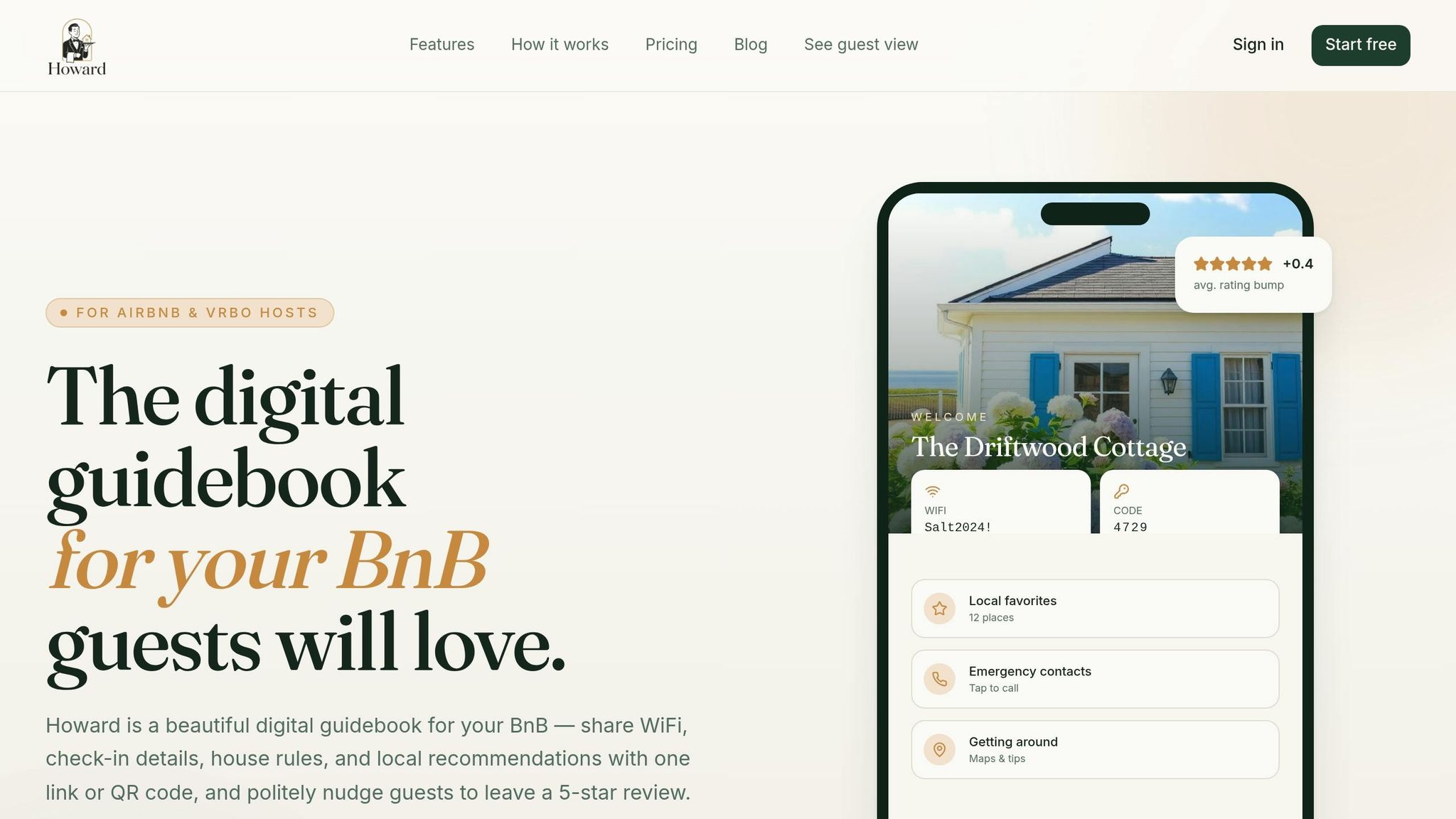
Howard's digital guidebook platform is tailor-made for Airbnb hosts juggling multiple properties. The setup is quick, with listing data auto-imported in minutes. Once ready, the guidebook can be shared via a link or QR code - no app downloads required.
The platform includes an AI-powered FAQ system that instantly answers common guest questions. For more complex queries, messages are routed to you directly via Slack or email. You can even print QR code cards and place them in key areas of your property, ensuring guests have immediate access to house rules and local tips.
For hosts managing several listings, Howard's centralized dashboard makes it easy to duplicate and customize guidebooks for each property.
"Setup took 5 minutes. The review nudge alone has paid for Howard ten times over in the first month." – Daniel K., Superhost
Howard doesn't just save time - it simplifies property management while enhancing the guest experience.
Howard Features for Managing Multiple Properties
Howard goes beyond guidebooks to help hosts manage their properties more efficiently. Automated review reminders are sent on the last day of a guest's stay, encouraging them to leave feedback while their experience is still fresh. The centralized dashboard lets you oversee calendars, pricing, and guest communication for all your listings in one place.
Other features include custom branding options and upcoming multi-language support, making it easier to establish a recognizable identity for hosts welcoming international travelers. Howard currently boasts a 4.9/5 rating from over 1,200 hosts.
Howard Pricing Plans
Howard offers flexible pricing to suit hosts at every level:
| Plan | Price | Best For | Key Features |
|---|---|---|---|
| Solo Host | Free forever | Hosts with 1 property | 1 property, digital guidebook, QR code, shareable link, basic FAQ |
| Superhost | $12/property/month | Hosts serious about ratings | Unlimited properties, smart review nudges, AI concierge, custom branding, multi-language support |
| Your Own App | Custom pricing | Hosts building a brand | Branded native app, custom domain, App Store/Play Store listing, dedicated success manager |
The Solo Host plan is completely free and works indefinitely for a single property. The Superhost plan, priced at $12 per property per month, scales seamlessly as you grow your portfolio.
Growing Your Portfolio While Maintaining Quality
Expanding your Airbnb portfolio can be exciting, but it comes with challenges - chief among them is maintaining quality. Letting standards slip can lead to costly repairs and unhappy guests. For example, reactive repairs are 4.2 times more expensive than preventive maintenance caught during routine inspections. Even worse, 72% of guest complaints involve unresolved maintenance issues known before check-in. When you’re juggling multiple properties, these small oversights can snowball quickly.
"A maintenance calendar is not just a housekeeping routine. It is a real investing tool that helps you safeguard your asset, protect your cash flow, and deliver a guest experience that stays consistently five star." – Awning Editorial Team
Taking a proactive approach to maintenance not only saves money but also keeps guest complaints to a minimum. Pair this with dynamic pricing strategies to ensure steady revenue, and you’ll have the resources to maintain high standards. Properties with ratings of 4.7 or higher receive 60% more bookings, creating a positive feedback loop where quality drives revenue, which in turn funds future improvements. Let’s look at how you can implement regular maintenance and optimize pricing to ensure growth without sacrificing guest satisfaction.
Setting Up Regular Maintenance Schedules
As your portfolio grows, maintaining consistent quality across all properties becomes critical. Preventive maintenance can reduce costs by 34% on average. To achieve this, a structured schedule for daily, monthly, quarterly, and annual tasks is essential.
For every turnover, focus on essentials: testing smart locks, checking light bulbs, ensuring appliances work, and inspecting for leaks under sinks. Monthly tasks should include testing GFCI outlets, replacing smoke and CO detector batteries, inspecting grout and caulk, and cleaning HVAC filters. Quarterly, you’ll want to deep clean upholstery, perform pest control treatments, and inspect roofs and gutters. Annually, schedule professional HVAC servicing, flush water heater sediment, and clean dryer exhaust ducts.
Standardization is key. About 80% of maintenance tasks are consistent across properties. Create a master checklist for these shared tasks, and then customize additional lists for unique amenities like hot tubs or outdoor grills.
| Maintenance Frequency | Key Tasks to Perform |
|---|---|
| Every Turnover | Test smart locks, check light bulbs, verify appliances, inspect for leaks under sinks |
| Monthly | Test GFCI outlets, replace smoke/CO detector batteries, inspect grout/caulk, clean HVAC filters |
| Quarterly | Deep clean upholstery/rugs, perform pest control, inspect roofs/gutters |
| Annual | Professional HVAC service, flush water heater sediment, clean dryer exhaust ducts |
Digital tools can help streamline this process. Platforms for maintenance management allow you to assign tasks, track progress, and ensure all flagged issues are resolved before the next guest arrives.
"The first thing I noticed after going digital was that my cleaners started flagging issues they would have previously messaged me about and forgotten. When it goes into a work order, someone has to close it." – Short-Term Rental Portfolio Manager
Budgeting for maintenance is equally important. Allocate 5% to 8% of your gross monthly rent for preventive work. Alternatively, you can set aside 1% of the property’s total value annually or $1 per square foot for yearly maintenance costs.
Using Dynamic Pricing to Maximize Revenue
Once you’ve established solid maintenance practices, dynamic pricing can help you boost profitability. Properties using advanced revenue management systems typically see 15% to 25% higher occupancy rates compared to those relying on basic pricing methods. The key is frequent adjustments - successful hosts update rates every 3 to 5 days based on market demand and competitor trends.
Set a base rate with minimum and maximum thresholds so dynamic pricing can adjust rates automatically in response to demand. For hosts managing multiple properties, applying global pricing rules across listings ensures consistency and reduces errors.
Encouraging longer stays is another way to optimize revenue. Offering weekly or monthly discounts reduces turnover costs and operational complexity. Fewer turnovers mean lower cleaning expenses and less wear and tear on your properties.
There’s a direct link between maintenance and pricing. Properties with consistent maintenance and 5-star cleanliness ratings can command higher rates. Automated guest communication further boosts review scores from an average of 4.2 to 4.8 stars, making it easier to justify premium pricing.
Regularly monitor competitor rates and analyze what sets your properties apart - like unique amenities or location perks. Use this information to adjust pricing dynamically, staying competitive without constant manual updates.
"I'll increase your revenue by 20-40% with dynamic pricing and optimized listings, and you'll never touch an Airbnb message again. My fee pays for itself in the first month." – ScaleDoors
Managing your portfolio as a whole, rather than treating each property individually, helps balance risks and rewards. Combining systematic maintenance with smart pricing strategies ensures your portfolio remains profitable and maintains its reputation for quality.
Common Problems and How to Solve Them
Managing multiple Airbnb properties comes with its fair share of challenges, but most can be tackled effectively with the right systems in place. Let’s dive into a few of the most frequent issues and how to address them.
Excessive guest messaging is one of the biggest hurdles for hosts managing 8 to 12 properties. At this scale, manually handling inquiries can quickly become overwhelming. Common questions often revolve around check-in instructions, appliance usage, checkout procedures, local recommendations, and occasional complaints.
The pressure to respond quickly is intense. For Superhost status, Airbnb requires a 90% response rate within 24 hours, but to maintain high search rankings, responding within an hour is often necessary. Missing just 4 out of 40 messages annually could cost you your Superhost badge. This is where automation becomes a lifesaver. Automating responses for key touchpoints - booking confirmations, check-in details, mid-stay check-ins, and checkout reminders - can significantly reduce the workload.
Information accuracy is another area that becomes tricky as your portfolio grows. Managing unique details for each property, like WiFi passwords, parking instructions, and lock codes, can lead to errors if not handled systematically. To prevent mistakes, create a detailed knowledge base for each property, covering 40 to 80 potential guest questions - everything from access codes to HOA rules and appliance quirks. Use AI drafting tools to pull from this database and set up redundant notifications through both your property management system and Airbnb’s app to avoid sync delays. Accurate information not only prevents scheduling conflicts but also keeps operations running smoothly.
Scheduling conflicts and double bookings are another pain point. The solution? Use API-based channel managers that synchronize availability across booking platforms in real time. Unlike free iCal syncing, which can lag, these tools ensure up-to-the-minute accuracy. Also, always have at least two backup cleaning teams ready to step in for last-minute emergencies or turnovers.
"A reply that says 'Good question, let me check on that for you' sent within 10 minutes does more for your rate than a perfect answer sent 8 hours later." – Hostrexa Team
Emergency maintenance is inevitable, so it’s crucial to be prepared. Maintain a vetted list of local plumbers, electricians, and handymen for each area you operate in. This ensures you can provide a 24/7 response to issues. Aim to respond to emergencies within 15 minutes to avoid negative reviews. To make things easier for guests, include a direct phone number in your automated welcome messages so they can bypass technical issues during urgent situations.
Conclusion
Achieving success hinges on centralization, automation, and dependable systems. A unified dashboard can simplify operations by eliminating overwhelming manual updates and avoiding scheduling conflicts. Without well-structured processes in place, scaling operations becomes far more difficult to sustain.
Automation plays a key role in reducing workload while boosting overall efficiency. For instance, setting up automated messages for booking confirmations, check-in details, mid-stay updates, and checkout reminders not only saves time but also ensures consistent communication with guests. Tools designed for automation can also simplify messaging and guidebook management, removing the hassle of repeatedly answering the same questions for multiple properties.
Equally important is building a reliable team. Standardized checklists and clear standard operating procedures (SOPs) empower your team to deliver consistent quality, even as your operations grow.
FAQs
When should I switch to a PMS?
Managing multiple Airbnb properties can quickly become overwhelming, especially as your portfolio grows. That's when a property management system (PMS) becomes essential. A PMS can automate repetitive tasks, centralize your operations, and help you maintain high standards across all your listings. If juggling everything manually starts eating up too much time or feels chaotic, it's a strong indication that a PMS can help you streamline your processes and stay organized.
What should I automate first across listings?
The first step to simplifying your listings is automating guest communication. Start by automating tasks like messaging, sending check-in instructions, and requesting reviews. This not only cuts down on manual work but also enhances the guest experience and keeps your operations running smoothly - particularly if you're juggling multiple properties. Automating communication lays the groundwork for scaling your Airbnb business efficiently.
How do I prevent quality from slipping as I scale?
Scaling your Airbnb operations can feel like a juggling act, but keeping quality intact is absolutely doable with the right approach. Here’s how:
Start by creating detailed Standard Operating Procedures (SOPs) for essential tasks like check-ins, cleaning routines, and guest communication. These step-by-step guides ensure everyone on your team knows exactly what’s expected, minimizing confusion and keeping things consistent across properties.
Next, take advantage of automation tools. Automating repetitive tasks - like sending check-in instructions or scheduling cleanings - saves time and reduces the risk of human error. Tools like property management software can be a game-changer here.
Don’t forget about your team! Regular training sessions are crucial to keep everyone aligned with your service standards. And building strong relationships with your cleaners and maintenance staff is just as important. These partnerships are your backbone for maintaining consistency, so make sure they’re solid.
Ultimately, scaling successfully means focusing on standardization and having reliable support systems in place. These strategies will help you maintain the high-quality service your guests expect, even as you grow.